
Acute lymphoblastic leukaemia (ALL)
About Cancer > Acute lymphoblastic leukaemia (ALL)
Acute lymphoblastic leukaemia (ALL)
What is chronic myeloid leukaemia (CML)?
How chronic myeloid leukaemia develops
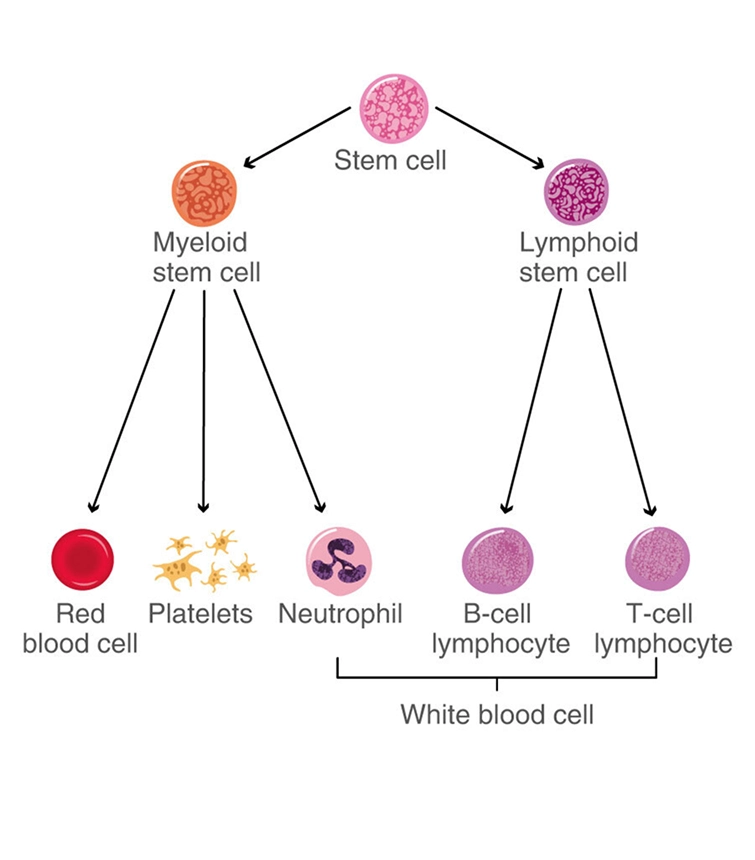
All blood cells are made from blood stem cells. These are blood cells at the earliest stage of their development. Blood stem cells develop into the following 2 types:
- Lymphoid stem cells make white blood cells called lymphocytes.
- Myeloid stem cells make all the other types of blood cell. These include red blood cells, platelets and other white blood cells, such as neutrophils.
CML develops because of a genetic change in the stem cells. This change stops them developing into normal myeloid cells. We have more information about genes and chromosomes in chronic myeloid leukaemia (CML).
How blood cells divide
Symptoms of chronic myeloid leukaemia (CML)
Chronic myeloid leukaemia (CML) usually develops slowly. Many people do not have symptoms in the early stages. Sometimes CML is found by chance. This might be when someone has a blood test before an operation, or as part of a routine health check.
Sometimes in the early stages of CML, symptoms can be mild. They may be confused with the symptoms of more common illnesses, such as flu.
We have more information about general symptoms of leukaemia.
Causes of chronic myeloid leukaemia (CML)
Doctors do not know the exact causes of CML. But there are risk factors that can increase your chance of developing it.
Age
Sex
Lorem ipsum dolor sit amet, consectetur adipiscing elit, sed do eiusmod tempor incididunt ut labore et dolore magna aliqua. Ut enim ad minim veniam
Radiation exposure
Lorem ipsum dolor sit amet, consectetur adipiscing elit, sed do eiusmod tempor incididunt ut labore et dolore magna aliqua. Ut enim ad minim veniam
Diagnosis of chronic myeloid leukaemia (CML)
Blood tests
You will have blood tests at the hospital. These tests will:
- check the numbers of blood cells in your blood – this is called a full blood count (FBC)
- look for leukaemia cells.
If there are leukaemia cells in your blood, the haematologist will arrange more tests. These will find what type of leukaemia you have and what phase it is. This will help your doctors plan your treatment.
Bone marrow biopsy
Lorem ipsum dolor sit amet, consectetur adipiscing elit, sed do eiusmod tempor incididunt ut labore et dolore magna aliqua. Ut enim ad minim veniam
Ultrasound scan
Lorem ipsum dolor sit amet, consectetur adipiscing elit, sed do eiusmod tempor incididunt ut labore et dolore magna aliqua. Ut enim ad minim veniam
Cytogenetic and molecular tests
Philadelphia chromosome test
Lorem ipsum dolor sit amet, consectetur adipiscing elit, sed do eiusmod tempor incididunt ut labore et dolore magna aliqua. Ut enim ad minim veniam, quis nostrud exercitation ullamco
Lorem ipsum dolor sit amet, consectetur adipiscing elit, sed do eiusmod tempor incididunt ut labore et dolore magna aliqua.
Polymerase chain reaction (PCR) test
Lorem ipsum dolor sit amet, consectetur adipiscing elit, sed do eiusmod tempor incididunt ut labore et dolore magna aliqua. Ut enim ad minim veniam
FISH testing
Lorem ipsum dolor sit amet, consectetur adipiscing elit, sed do eiusmod tempor incididunt ut labore et dolore magna aliqua. Ut enim ad minim veniam
Phases of chronic myeloid leukaemia (CML)
The treatment you have depends on the phase of chronic myeloid leukaemia (CML). CML usually develops slowly. The 3 phases of CML are the:
- chronic phase
- accelerated phase
- blast phase.
Doctors know the phase of CML from:
- the number of immature blood cells (blast cells) in your blood and bone marrow
- your symptoms.
Most people are diagnosed when CML is in the chronic phase.
Chronic phase
When CML is in the chronic phase, there may be no symptoms. Most people can live a normal life. Treatment is tablets you can take at home. You have regular blood tests to check how well the treatment is working.
For most people, the leukaemia can be well controlled for as long as treatment continues.
In the chronic phase, less than 15 in 100 blood cells in the blood or bone marrow (15%) are blast cells.
Accelerated phase
Lorem ipsum dolor sit amet, consectetur adipiscing elit, sed do eiusmod tempor incididunt ut labore et dolore magna aliqua. Ut enim ad minim veniam
Blast phase
Lorem ipsum dolor sit amet, consectetur adipiscing elit, sed do eiusmod tempor incididunt ut labore et dolore magna aliqua. Ut enim ad minim veniam
Relapse
Lorem ipsum dolor sit amet, consectetur adipiscing elit, sed do eiusmod tempor incididunt ut labore et dolore magna aliqua. Ut enim ad minim veniam
Risk score of chronic myeloid leukaemia (CML)
As well as the phase of CML, your cancer doctor will calculate your risk score. This can help them to plan the best treatment for you.
Risk scores are based on:
- your age
- the size of your spleen
- the number of blast
- cells in your blood
- your platelet count.
Depending on the risk score, people with CML can be grouped into 3 risk groups:
- low
- intermediate
- high.
Knowing the risk group can give your haematologist an idea of how likely the CML is to respond well to treatment.
Most people with CML respond to tyrosine kinase inhibitor drugs (TKIs) regardless of their risk score.
Treatment for chronic myeloid leukaemia (CML)
A team of specialists will meet to discuss the best possible treatment for you. This is called a multidisciplinary team (MDT).
Your haematologist or specialist nurse will explain the different treatments and their side effects. They will also talk to you about things to consider when making treatment decisions. You will need this information before you give your permission (consent) to have any treatment.
The aim of treatment is to put CML into remission and keep it in remission. This means there are no signs of CML in your PCR blood test, and you feel well. There are different levels of remission.
Treatments may include:
Tyrosine Kinase Inhibitors (TKIs)
Chemotherapy
Lorem ipsum dolor sit amet, consectetur adipiscing elit, sed do eiusmod tempor incididunt ut labore et dolore magna aliqua. Ut enim ad minim veniam
Interferon alpha
Lorem ipsum dolor sit amet, consectetur adipiscing elit, sed do eiusmod tempor incididunt ut labore et dolore magna aliqua. Ut enim ad minim veniam
Leukapheresis
Lorem ipsum dolor sit amet, consectetur adipiscing elit, sed do eiusmod tempor incididunt ut labore et dolore magna aliqua. Ut enim ad minim veniam